DISTRIBUTED SYSTEMS
The Future of Distributed Systems: Beyond Microservices
Exploring the evolution from monoliths to microservices and what comes next in distributed architecture.
October 25, 2025
8 min read
By Lundi Zolisa Silolo
#microservices#architecture#scalability#serverless#event-driven
The Future of Distributed Systems: Beyond Microservices
The journey from monolithic architectures to microservices has been transformative, but we're just getting started. As systems become more complex and data volumes explode, we need to think beyond traditional patterns.
The Current State
Microservices solved many problems:
- Independent deployments
- Technology diversity
- Team autonomy
- Fault isolation
But they introduced new challenges:
- Network complexity
- Data consistency
- Operational overhead
- Debugging difficulties
What's Next?
I believe the future lies in Event-Driven Architectures combined with Serverless Computing. Here's why:
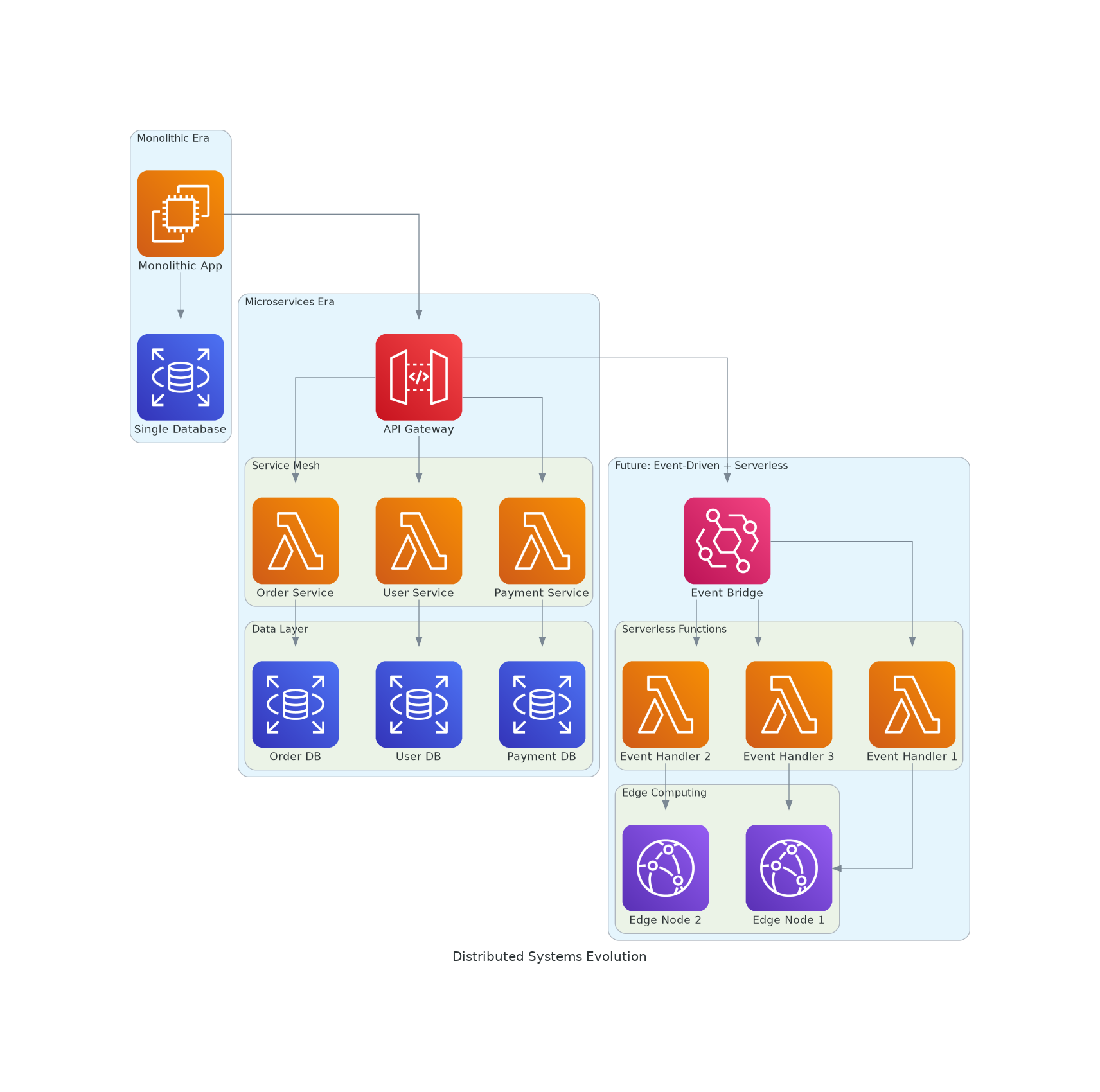
The evolution from monoliths to microservices to event-driven serverless architectures
Event Sourcing as the Foundation
Instead of thinking in terms of services, think in terms of events. Every state change becomes an immutable event, creating a natural audit trail and enabling powerful replay capabilities.
Serverless-First Design
Functions that respond to events, scale to zero, and charge only for execution time. This isn't just about cost - it's about simplicity and focus.
Edge Computing Integration
Bringing computation closer to data sources reduces latency and enables real-time processing at unprecedented scales.
The AWS Perspective
Working with AWS services like Lambda, EventBridge, and Step Functions has shown me how powerful this paradigm can be. The key is designing for:
- Idempotency: Every operation should be safely retryable
- Observability: Events create natural monitoring points
- Resilience: Failures become events that can be processed
Conclusion
The future of distributed systems isn't just about breaking things apart - it's about creating intelligent, self-healing networks of computation that adapt to changing demands.
What do you think? Are we ready for this shift?